Sports Fandom: Ties That Bind, One Season at a Time
October 1, 2026



October 1, 2026

At Beatitudes Campus, sports fandom is just one of the many ways residents live out loud. Whether it’s cheering from the stands or pursuing a passion all their own, a spirit of community, identity and joy shows up everywhere you look.
Harriet, known affectionately as “Hootie,” never considered herself athletic. Growing up, sports weren’t her thing, though she dabbled in golf and survived a few tennis lessons mostly by ducking. She had no idea the WNBA existed, let alone that the Phoenix Mercury would be one of its eight inaugural teams.
That changed in March 1997, when her partner, Peggy, handed her a birthday card with a home opener ticket tucked inside. “I thought, ‘Bless your heart, I thought you knew me better than this,’” Hootie said.
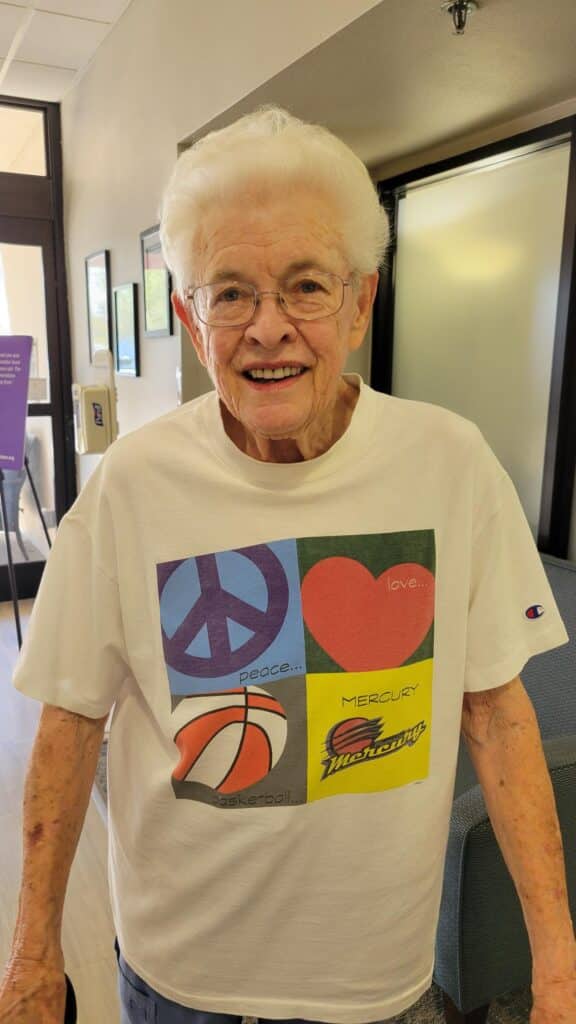
On June 22 that summer, the Mercury took the court for the first time against the Charlotte Sting, and Hootie was hooked before halftime. “During intermission, we went and bought season tickets,” she said.
What started as a birthday surprise turned into a 19-season tradition, one Hootie and Peggy kept up until the drive into downtown Phoenix became too much. Decades later, Hootie still has her original Mercury T-shirt from that first season, a favorite reminder of where it all began.
Her story is a familiar one at Beatitudes Campus, where “Mighty Mercury” love runs deep. For these residents, cheering from the stands or the couch does more than pass the time. The fan benefits of following the team — a lasting sense of belonging, purpose and connection — carry as much weight as the score on the board.
Ask any longtime sports fan why they stick with a team through good seasons and bad, and community usually comes up. For Hootie, camaraderie showed up everywhere.
The “Sisters of No Mercy” was a group of women who dressed as nuns waving rulers and heckled visiting teams from behind their section during the Mercury’s first few seasons. Hootie also recalled the ‘frozen yogurt joint’ where she and Peggy stopped after night games, which became an unofficial gathering spot for fellow fans heading home in the same direction.
For another resident, Phil, community shows up on campus. A Mercury season ticket holder for 30 years, he passes his tickets along to fellow residents Laura and Melissa when he can’t make a game himself.
“Being a fan brings you closer to the teams and players,” he said. That connection carries into his other routines too. He plays darts twice a week and poker weekly, and sports come up in nearly every one of those gatherings. “We often discuss sports when participating in these other activities.”
Psychologist Daniel Wann, Ph.D. of Murray State University has spent decades studying the psychology of sports fans. His research explains why these friendships form so easily: People who identify strongly with a team report lower loneliness, less social isolation and higher self-esteem than those who don’t follow sports at all.
In an interview with the American Psychological Association, Dr. Wann said the more a fan identifies with a local team, the more likely they are to have a well-rounded sense of psychological health.
Why do people watch sports so consistently and why do people enjoy sports enough to build entire friendships around a season? Fandom offers a sense of belonging to something bigger than any one person, shared with a community that already gets the appeal.
Hootie put it simply, describing the X-Factor, Phoenix Mercury’s nickname for its dedicated fan base. “When the team played at home and had us behind them, they always did better,” she said. “We added something to them.”
Whether or not fans change the outcome on the court, believing they matter to the team is its own kind of psychological reward. And it’s part of why sports fanaticism, in moderation, builds people up rather than wearing them down.
Laura’s sports fandom runs deep enough that she still gets pulled into “coaching discussions” with fellow residents. A former high school coach for volleyball, basketball, softball and tennis, Laura grew up in the 1960s, when girls didn’t have organized school sports.
She played anyway, in college and beyond, across basketball, volleyball, field hockey, softball and badminton. When the WNBA arrived, it was ‘a dream come true’ for Laura.
“I’ve been a Mercury fan since day one. I love the sport and can get pretty carried away when cheering for my Mercury,” she said. “It’s a great feeling to see college women’s basketball grow and expand. You can see as many games as your heart desires on TV.”
That enthusiasm is exactly the benefit of watching sports Wann’s research points to. Passionate, vocal fandom gives people a healthy outlet for excitement and identity, especially when shared with others who feel just as strongly.
“Being in the arena when we have won our championships has been one of my greatest joys. It’s emotional for me as a woman who grew up loving sports,” Laura said. “Now youngsters can see the great talent these women are showing. Long time overdue!”
For many sports fans, the emotional pull reaches beyond the current season, touching everything a team or player has come to represent over the years. Few Mercury moments capture that better than Diana Taurasi’s professional career.
Drafted first overall in 2004, Taurasi played her entire 20-season WNBA career with Phoenix, becoming the league’s all-time leading scorer along the way. In August, the Mercury retired her jersey and inducted her into the team’s Ring of Honor.
Hootie fondly remembers watching the draft with Peggy at a sports bar packed with fellow season ticket holders. “We had Diana for 20 years, only playing for us, and while she was with us, we had three championships,” she said.
Today, Hootie still watches games with one of her original Mercury friends, who now lives down the hall from her at Beatitudes Campus. “We always want to win, but no matter what, we’re still having fun.”
In August, she watched Taurasi’s jersey retirement ceremony, calling it a “really, really, really incredibly important day.” The Mercury lost by two points that night, but Hootie noted with pride that no one in the arena left early.
Phil’s basketball connection stretches back even further, to when he and his wife were season ticket holders for Arizona State University women’s team in the early 1980s. When his wife asked for Mercury tickets as a 40th anniversary gift, right as the WNBA was just forming, becoming a founding member was an easy decision.
What makes sports fandom especially well-suited to later life is how easily it travels between generations and friendships. Phil’s wife passed away three years ago. He now brings his daughter, Tova, to games carrying on decades of tradition. Laura’s decades of coaching turned naturally into friendly sports debates with fellow residents. Hootie’s sports fanaticism is an enduring connection to her partner of 45 years who passed away in February.
Why do people like sports enough to build a life around following them? The benefits of watching sports rarely come down to the final score. They come from friendships formed in the stands, traditions passed down and preserved, and a sense of belonging that keeps people showing up, season after season, win or lose.
Interested in learning more about our community of spirited residents? Contact us today, to schedule a visit.
Featured Image: Alessandro Pintus / Shutterstock